A live stream loses its audio, and the monitoring system raises an alert. Is it time to act?
It depends. Dennis LeMire of FloSports explained why: at a hockey game, the silence can simply be the break between periods, while a zamboni, the machine that resurfaces the ice, circles the rink. A monitoring system sees the alert, and the people close to the event know what it means. That difference is context.
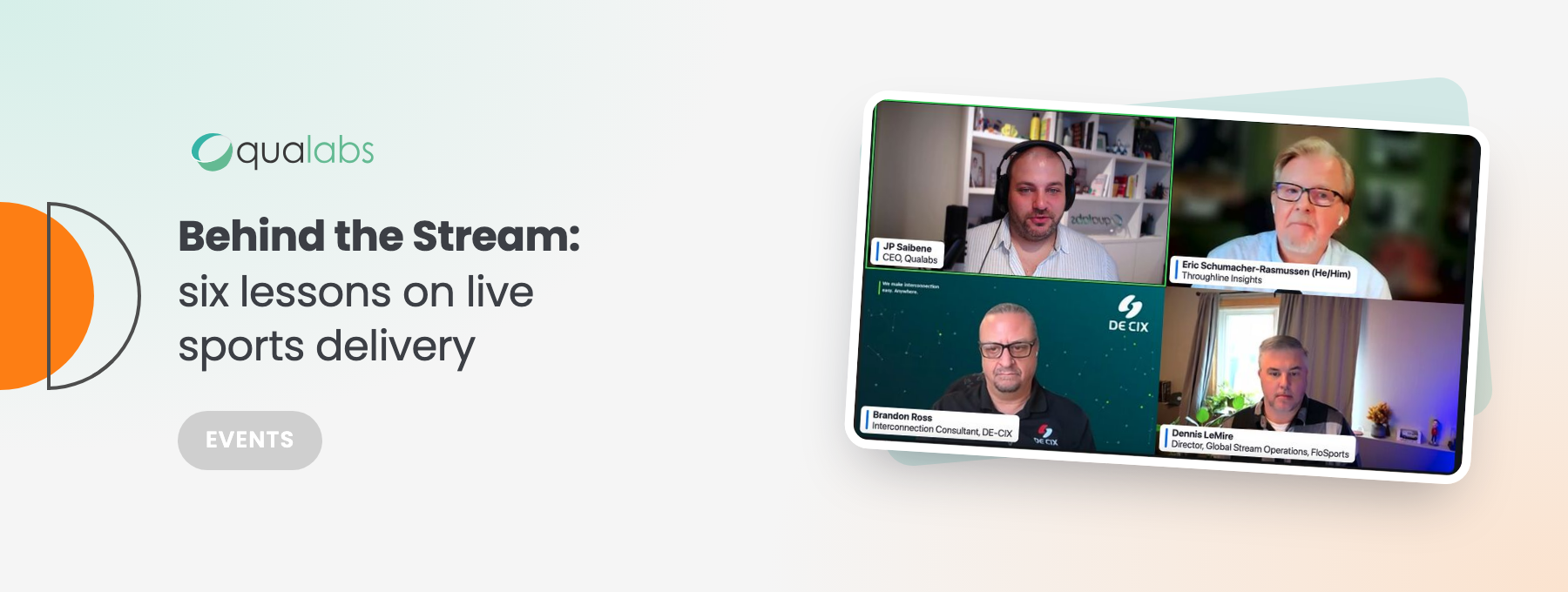
That moment came up in "Unbreakable: Maximizing QoE With Resilient, Scalable Sports Streaming Infrastructure," a Streaming Media Connect 2026 session moderated by Eric Schumacher-Rasmussen. Three specialties shared the stage: Dennis LeMire, Director of Stream Operations at FloSports, on the platform and its production partners; Brandon Ross, Interconnection Consultant at DE-CIX, on where content networks meet viewer networks; and our CEO JP Saibene, on building and operating streaming pipelines. The conversation followed a live event in three moments, and we follow the same path here: getting ready, seeing clearly, and deciding when to act.
 ModeratorEric Schumacher-Rasmussen
 SpeakerDennis LeMireFloSports
 SpeakerBrandon RossDE-CIX
 SpeakerJP SaibeneQualabs
Here is what you will find in this post:
- Why audiences keep growing about twenty minutes into a game, and what that means for capacity
- How one team ran about twenty thousand tests in three weeks
- How redundancy and path diversity strengthen a network
- How every monitoring tool can be correct while the full picture stays incomplete
- The story of four channels that never existed, and the plugin behind them
- Where automation earns the right to act, and where a person stays in the loop
1. Capacity planning: audiences peak twenty minutes into the game
Preparation starts with when the audience arrives. DE-CIX traffic data points to a later moment than kickoff:
We find that those viewers all seem to peak right about twenty minutes into the game. So even if you were prepared at the beginning of the game, you have to be prepared for the whole game.
Brandon cited combined exchange traffic of nearly 30 Tbps during an Argentina versus Egypt World Cup 2026 match and more than 32 Tbps for a Champions League 2026 match, a record for those exchanges. FloSports described the other end of the scale: in a typical week, 1,400 to 1,500 events with 200 to 500 viewers each, alongside 14 to 20 events with hundreds of thousands. The smaller events benefit from the redundancy built for the larger ones.
2. Live event preparation: twenty thousand tests in three weeks
Capacity is one half of readiness, and partners are the other. FloSports covers thousands of events a year, and roughly 90 percent are produced by outside partners. Before its college season, the team ran around twenty thousand tests with those partners over three weeks.
Dennis's rule of thumb for connectivity:
Go with what you think you need, then double that.
3. Two links, one resilient network: redundancy and path diversity
Readiness also reaches the network between content and viewers. Brandon explained that redundancy counts the links, and diversity checks that they follow different routes. Links on different upstream paths give a network more room to adapt, and connecting directly removes many hops, which lowers latency and improves resilience at the same time. For FloSports, that consistency matters as much as speed, since a steady latency lets scoreboard data, score bug data, and video line up.
JP added the part of preparation that is easy to overlook, the path back from viewers:
Everybody rehearses the stream at scale, but almost nobody rehearses the data coming back. Your video goes one to many, but your telemetry goes many to one.
4. Streaming observability: every tool can be right while the picture is incomplete
Once the event is live, the question becomes how quickly a team can see what viewers see. Eric asked why a stream can stay below its best quality for a while before anyone can name the layer involved, given how many monitoring tools exist. JP's answer began with a point in favor of the tools:
The tools are not wrong. They're scoped. Everyone instruments their own layer against their own SLA, and every one of them sees green, because every one of them is correct about their own layer.
Viewers experience a workflow end to end, so the handoffs between layers benefit from an owner too. Averages add a second layer to the picture. In JP's example, a stall rate of half a percent could be background noise, or it could be every television of one model, in one country, on one ISP.
Eric raised the counterpoint many readers will share: dashboards are easy to buy and easy to build, and they feel good. Brandon agreed that dashboards and visibility are good, and added that they work best on top of reliable infrastructure. JP described what happens on a call when signals live in many places:
There's a context gap, not a tooling gap. Buying a seventh window is just going to make it worse.
5. Troubleshooting live streams: the cause can sit between layers
JP shared an example from Qualabs' own live operations that shows it in practice:
We were having 404s for four channels that never existed, and we were like, why?
The origin, the CDN, and the player were each checked in turn, and each worked as designed. The cause was an open-source plugin built to get closer to zero latency. It requested segments the origin had not created yet, and the cache servers stored the 404s. The turning point came when someone on the team asked what an outside actor might be doing to the stack. That question led to a Chrome plugin that read a CMCD flag incorrectly and treated a live event as VOD. Qualabs sent a pull request to the open-source project.
- OriginWorked as designed
- CDNWorked as designed
- PlayerWorked as designed
- Chrome pluginRead a CMCD flag incorrectly and treated live as VOD
Looking at the layers together is what brought the cause into view, and it is why JP closed this part with a metric worth borrowing:
Start measuring not only time to fix, but time to know. There's a gap between the first degraded viewer and the first human who can actually name what went wrong, and most teams never measure it.
6. AI in live streaming operations: automation grows by earning authority
Knowing which layer to look at leads to the next question. Eric asked the panel whether AI-triggered failover should ever run without a person involved, and each panelist answered from their own specialty. At the production layer, Dennis described how knowing what a stream should contain makes an automated fix safe:
The score bug goes down, AI can refresh that source and bring it back up, because it knows it's supposed to have a score bug. We're careful, because in some sports it's not supposed to have one at that point.
FloSports also plans its interventions for natural breaks in play, so a moment that may turn out to be the one fans remember is not interrupted. At the network layer, Brandon shared that AI-driven reactions are still taking shape. From the operations side, JP explained how Qualabs thinks about authority:
What is graded is how much authority each action carries. And the dial is not AI versus human. It is deterministic against probabilistic, and reversible against irreversible.
Which brings the panel back to the hockey game. A system can recognize that a feed has gone quiet, and the people close to the event know it is the intermission. Pairing the two, with actions that earn more autonomy as they prove reliable, is how teams get the speed of automation and the judgment of experience.
Live sports streaming operations: working across the chain
Conversations like this one are useful to us because they bring in parts of the chain that sit beyond our day-to-day: the production partners behind a broadcast, and the exchanges where networks meet. At Qualabs we run live operations for other teams' platforms, and our engineers sit in client bridges, alongside the teams who own each part of the chain. That vantage point shaped how we build.
What we saw repeatedly is that the same incident could take twenty minutes or an hour, depending on who was on shift. Our response was to make the experience of the most seasoned engineer available to everyone on the call. Today that includes agents for parts of the chain, such as ingest, media workflows, ad operations, delivery, and networking, grounded in each client's own playbooks, runbooks, and resolution history. Detection stays deterministic, and people decide how much authority each action carries.
We are glad to work alongside teams at each of these points, from platform and production to interconnection, so that when an event starts, everyone on the bridge shares the same picture and is ready to act on it.
Key takeaways for live sports streaming teams
- The audience builds. Viewership peaks around twenty minutes into a game, so plan for the whole event.
- Preparation is a team effort. Partner interviews, extensive testing with partners, and doubled connectivity set up the event before it begins.
- Pair redundancy with diversity. Links that follow different upstream paths give a network more room to adapt.
- Context connects the tools. Each layer can be right about itself, and time to know is a metric that spans them.
- Test beyond the happy path. Requests can come from beyond your own player.
- Let automation earn authority. Reversible, well-understood actions can run on their own, and people bring the context behind each decision.
Take a look at the full session!
Thank you to Dennis LeMire and Brandon Ross for the openness they brought to the conversation, to Eric Schumacher-Rasmussen for guiding it with thoughtful questions, and to the Streaming Media team for hosting Streaming Media Connect 2026. The full session is now available on the Streaming Media YouTube channel.