A FAST channel earns cents per viewing hour, and revenue per viewing hour has been falling in recent years. On top of that, ad-supported connected TV runs at 65% of its commercial capacity.
At those margins, the gap between a profitable channel and an unprofitable one is rarely just content. It sits in the engineering that turns viewing hours into impressions that are sold and paid for. And that engineering almost never shows up on the dashboard of whoever owns the revenue number.
Why does a FAST channel's margin depend on engineering?
Because a viewing hour only turns into revenue if a whole technical chain works: the metadata that gets you found, the markers that open each ad break, ad insertion, delivery to each platform, and the schedule that fills the day. Every link that fails is a leak, and most of them fail silently. The video keeps playing, but the money doesn't arrive.
Many channels sell only 20% to 40% of their available inventory. Part of that gap is demand. Part of it is engineering, and that part can be fixed.
What happens: lost or misplaced break markers, ads that don't arrive in time, breaks nobody can sell.
Warning sign: slates where ads should be.
What happens: platforms surface you less, viewers don't find you, and advertisers can't tell what they're buying.
Warning sign: programs with no genre, image or description in the guide.
What happens: every platform has its own spec, and every manual adaptation is a source of errors.
Warning sign: rejections, fixes and empty guide slots after every change.
What happens: the team spends the month building grids and plugging gaps instead of improving the channel.
Warning sign: every new channel means hiring.
How much revenue leaks out of ad breaks?
You lose every break that never gets sold or never plays, and it is the most expensive leak because the business can't see it. The dashboard shows viewing hours in green while the breaks go out empty.
The causes are engineering. The SCTE-35 markers that open each break get dropped when the signal is transcoded or repackaged, arrive with the wrong duration, or don't line up across video renditions. Breaks run to lengths no ad can fill. The ad server doesn't answer in time and a slate goes on air. Across the industry, ad insertion was the top technical challenge for 38% of video teams.
An empty break isn't neutral, either. The viewer sees a slate instead of content and is more likely to change the channel. That is why the first check on any FAST channel is to compare scheduled breaks with paid impressions.
How do metadata and guide data affect revenue?
Metadata decides whether platforms surface you and whether advertisers know what they're buying. With about 1,870 FAST channels competing for a spot in the guide, a program with no genre, no image or a generic description loses to the one next to it.
In a 2026 survey of 28 industry leaders, 86% said poor metadata is already costing them ad revenue, and the same share pointed to weaker discovery or platforms deprioritizing their content. 71% said the metadata they get from content owners arrives incomplete. Metadata isn't admin work. It is part of the product you sell.
Why does delivering to each platform multiply work and errors?
Because every platform asks for its own spec: stream format, break marker syntax, guide format, images and metadata. In the same survey, 86% named reformatting metadata for each platform's requirements as their biggest operational burden.
When each delivery is adapted by hand, every new platform adds a workflow someone has to maintain, and every schedule change has to be repeated with room for error. It shows up as rejections, empty guide slots or breaks a platform doesn't recognize. The alternative is a single source of truth that generates and validates every delivery.
What does it cost to schedule 730 hours a month by hand?
Manual scheduling makes the team the channel's biggest fixed cost, and that cost grows with every channel you add. A month has roughly 730 hours, and each one needs content assigned, a clean transition and breaks in the right place.
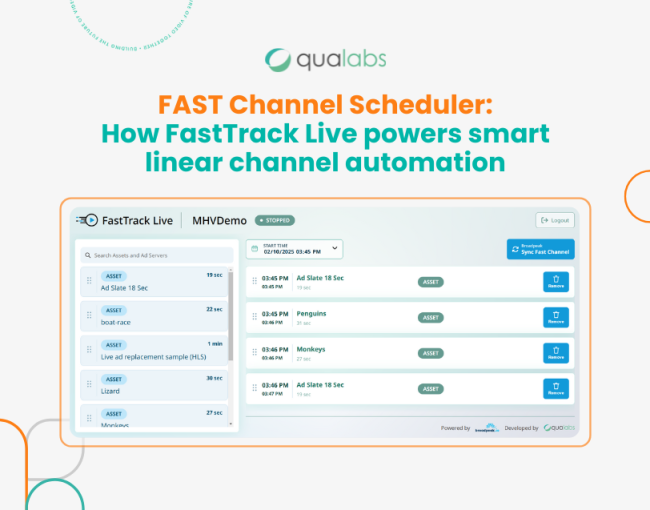
For a media and entertainment company, our team built a proof of concept that turns its on-demand catalog into a continuous linear channel. The schedule is generated automatically, transitions between assets are handled with DASH multi-period without re-encoding the catalog, and when an asset is missing it is replaced automatically from other storage locations. The channel runs without live operations and without manual scheduling or monitoring work that grows with the catalog.
The industry is moving the same way: it is already working on standards for building linear channels from on-demand content.
What should you check on your FAST channel this week?
Six checks your team can run in a week, without changing vendors, to find out how much of your margin depends on engineering nobody is watching:
- Scheduled breaks vs. paid impressionsBy channel and by platform, for the same week. The difference is your leak.Ad breaks
- SCTE-35 markers after every stepThey should arrive intact, with the right duration and in every rendition, after transcoding and packaging.Ad breaks
- How often a slate airs instead of an adIn which breaks, at what time and on which platform. If you can't measure it, you've found your first problem.Ad breaks
- The guide for the next seven daysLook at it as a viewer on each platform: titles, descriptions, genres, images and ratings.Metadata
- Manual steps per deliveryHow many there are for each platform, and how many rejections or fixes you had last month.Deliveries
- Scheduling hours per weekHow much time the team spends building grids and plugging gaps, and how much that would grow with one more channel.Scheduling
How Qualabs helps you win back your FAST channel's margin
Our Specialized Engineering team works on the technical chain that turns viewing hours into revenue. Together with your team, we focus on three things:
- An end-to-end review of your ad chain, from break marker to paid impression, on every platform, to show you where inventory leaks and what to fix first.
- Automated scheduling from your on-demand catalog, with programming rules, transitions without re-encoding, gaps filled automatically and the guide generated from the same source.
- A single source of metadata with deliveries generated for each platform, validated before they go out, so adding a platform doesn't mean adding manual work.
If you run FAST channels, tell us which platforms you're on and we'll look together at where your channel's biggest leak is.