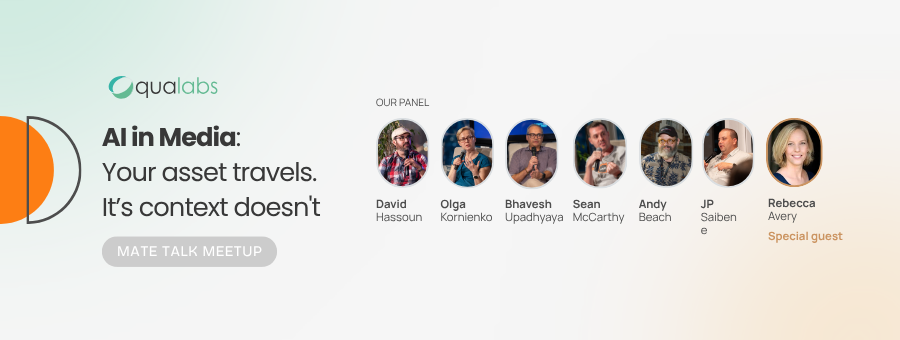
This time the question on the table was deceptively simple: what happens to context as AI moves into media workflows?
One conversation later, we'd covered provenance, runaway AI costs, the case for building (not buying) your own orchestration layer, and why this all feels a little like the cloud hype cycle from a decade ago. Here's the recap.
On the panel: Andy Beach (Alchemy Creations, Co Founder), Olga Kornienko (COO & co-founder, EZDRM), Bhavesh Upadhyaya (SVTA), Sean McCarthy (SVTA), Rebecca Avery, invited guest (Industry advisor, previously running her own consulting practice), David Hassoun (Chief Solutions Architect, Qualabs) and JP Saibene (Qualabs).
Trust, not truth
Everyone agrees content keeps losing its context as it moves through the pipeline, the "who made this, and can I trust it" question keeps getting harder to answer. Provenance standards like C2PA are the industry's best fix, but the panel spent real time correcting a common misread: C2PA proves who said something and that it wasn't altered. It doesn't prove it's true.
Think of it less as a lie detector and more as a receipt. Whether you trust what's on the receipt is still on you. That distinction matters more every month, and yet most people outside the industry have never heard of it, ask around at any event and you'll get blank stares followed by "wait, that would be so useful" once it clicks. With the EU AI Act pushing the issue forward, that's starting to change.
There's a second, quieter problem: standards move on a five-year cycle, AI models move on a three-month one. SMPTE's fix has been to move its spec work to GitHub, versioned and machine-readable, so an AI system can go fetch the current standard instead of working off whatever version it happened to be trained on.
The AI budget is going to the wrong layer
Nobody actually knows what AI costs right now, and that's not an accident. Token pricing abstracts the real cost of anything, and labs can reprice at will. Ask what it costs to run transcription today and the honest answer depends on assumptions that'll be different in six months.
The upshot: the foundation-model layer is racing toward a very low floor as labs undercut each other. The real, durable value sits one layer up, in the applications built on top. The panel's practical advice for anyone shipping AI features: treat the point where you call a model as a model registry, an internal marketplace you can swap models in and out of based on price or performance, with at least one self-hosted fallback always ready to go.
That logic extends to orchestration too. The "harness" controlling how a model spends tokens and what context it sees is doing a lot of invisible decision-making and if it's owned by a vendor, that vendor is incentivized to make it spend more. The clearest consensus of the night: build your orchestration layer, don't buy it. (BBC and ITN are doing exactly this with their joint "smart stories" project in the IBC Accelerator, deliberately keeping vendor bias out of the layer that holds their story data.)
One more contrarian note: a single do-everything LLM may not be the right fit for media work. Smaller, right-sized models with real guardrails are easier to secure, easier to reason about, and usually cheaper.
Build a master switch
Rebecca brought the operations reality check. Her pattern-matching, after months of talking to a wider range of companies than a typical client roster allows: independents who outsource their supply chain and then stop thinking about it entirely.
The hybrid that actually works: push the genuinely commodity stuff (encoding, packaging) out of house, keep metadata, authenticity checks, and chain-of-custody in-house, because that's where the real differentiation lives. Vendors selling generic "we'll boost your discoverability" are often doing the identical thing for every client, which just moves the table stakes.
That fed into a simple litmus test the whole panel landed on: before adopting any AI system, what's your plan if costs blow up, or a security issue forces you to pull it overnight?
Every AI workflow needs a "master switch", a non-AI fallback that lets you turn it off without breaking the product around it. Easy to skip while a proof of concept is working well; expensive not to have the day it isn't.
The cloud, again
Media companies rebuilding QA tooling on AI-generated code are quietly taking on tech debt, twenty-five years of hard-won FFmpeg expertise, for instance, now living inside a model someone has to maintain forever. It's a real tradeoff, not a free lunch.
Open-weight models running on local hardware are having a moment for the same reason: frontier-level output with nothing leaving the building, versus commercial models that are legally required to retain what you send them. The catch is everything that comes with owning infrastructure, headcount, energy costs, and missing out on the aggregate learning a widely-used shared model benefits from.
More than one panelist pointed out the déjà vu: this is almost exactly the "everything moves to the cloud" conversation from eight or nine years ago, before profitability pressure forced a rethink. Expect AI pricing to follow the same arc once the subsidized, land-grab-era pricing settles down.
Not every problem needs an AI
Does starting from scratch, no legacy workflows, no decades of process, count as an advantage right now? Pretty clearly yes, as long as new entrants bring their own ideas instead of letting AI generate their direction for them.
For bigger, more established players, the transformation ahead is bigger than swapping tools, it touches workforce development and how value gets created, all while much of the industry is still rebuilding teams after a rough few years of layoffs. And a reminder worth keeping close: not everything needs an AI system bolted onto it.
What to expect at IBC 2026
Quick-fire predictions from the panel:
- More data transparency conversations — what's being collected and how it's used, feeding straight into the provenance and rights debate, especially from European buyers.
- C2PA requests are up, and rising, a real signal the industry is moving from "what's that?" to actually implement it.
- Less AI hype, more business maturity — profitability and "does this actually solve a problem" replacing the AI-for-AI's-sake conversations of the last two years.
- Build-vs-buy decisions happening off the show floor — booths will still sell the flashy demo, but the real calls will hinge on where data lives and how it's used.
- More vendor co-marketing, fewer all-in-one platforms — ecosystems and integrations winning out over any single vendor trying to own the whole stack.
Summer Camp 2027
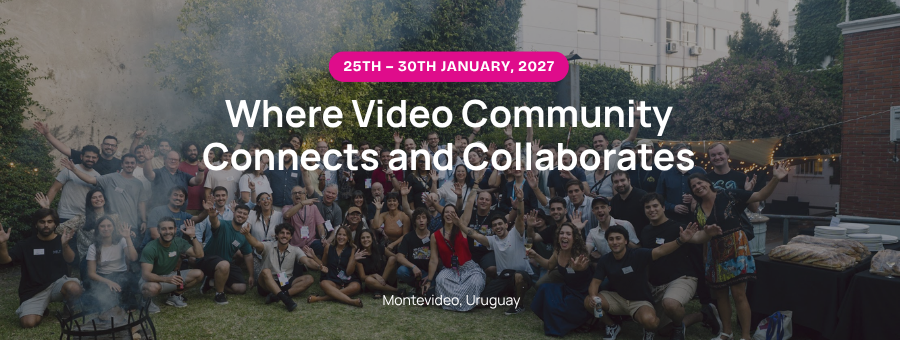
We announce the 5th edition of MonteVIDEO Tech Summer Camp, hosted by Qualabs.
It runs as two tracks: 3 months of remote collaboration (November 2026 through January 2027), plus an in-person Summer Week in Montevideo, Uruguay, from January 25-30.
This year's edition evolves the format: we're changing the question we ask campers. Until now we asked for projects, tell us what you'd like to build.
This time we're asking for something bigger! Not the problems you have today, those already have answers, we want the problem to come in 3 to 5 years, not what's annoying this quarter, but the one that needs five years of runway. The whole program will rally around that one shared question: what's the next big challenge in media and streaming?
If you've got ideas for what that challenge should be, or want to join, sign up at montevideotech.dev/summercamp2027.