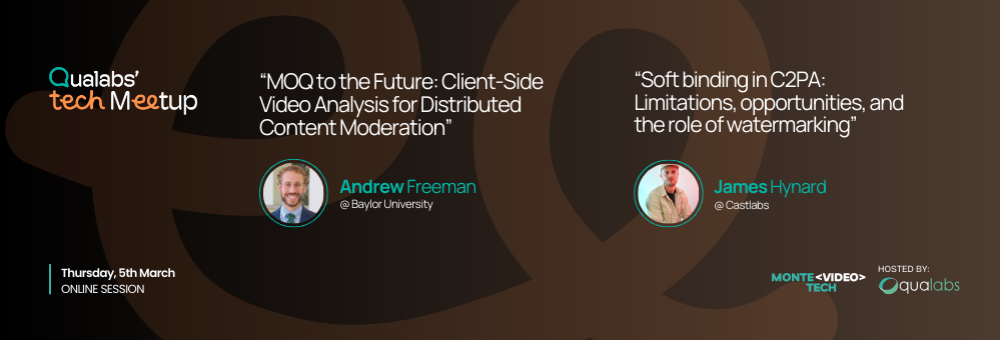
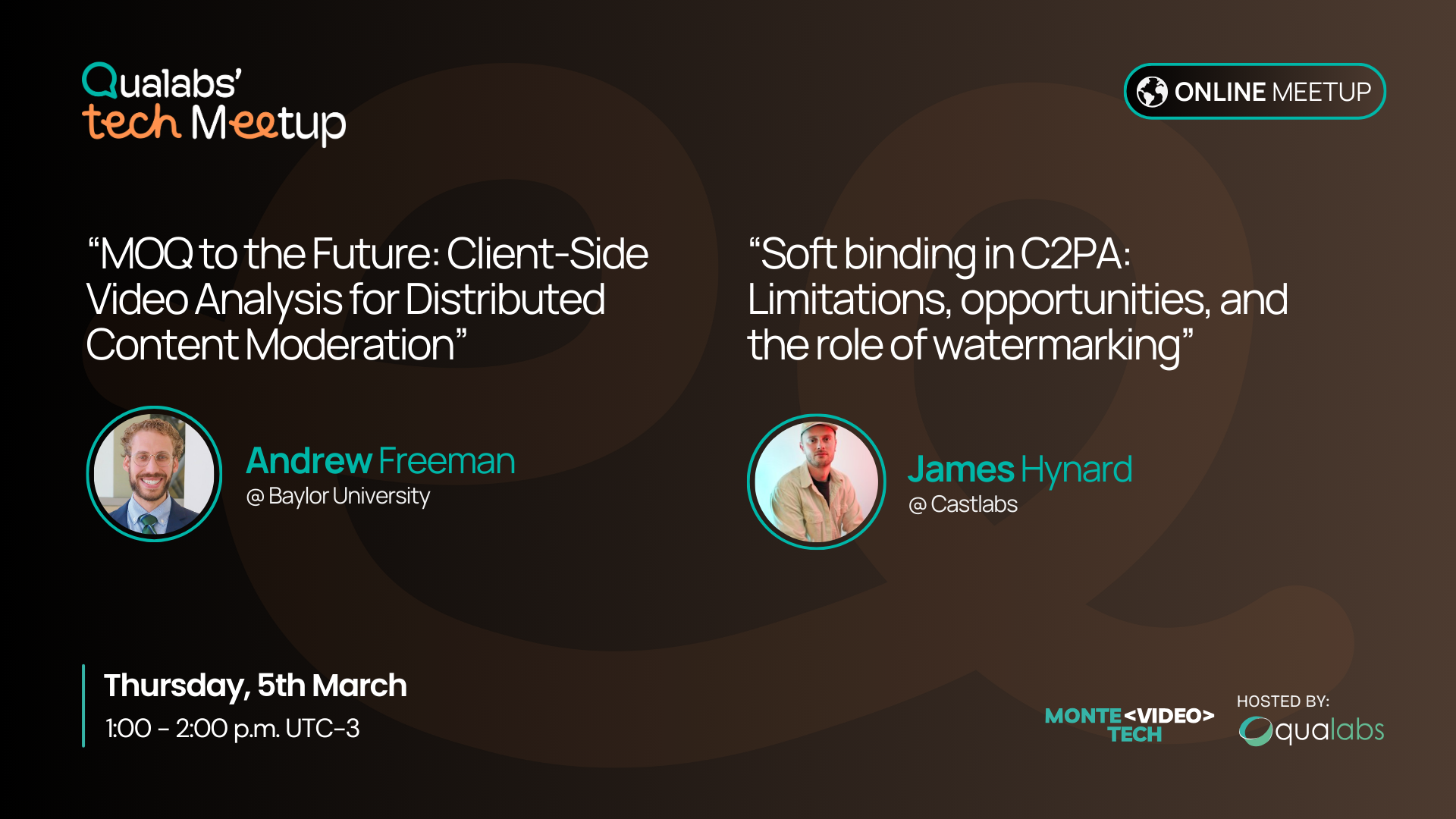
The first Qualabs’ Tech Meetup of 2026 opened by addressing two critical pillars of modern streaming: individual safety and media trust. As platforms struggle to moderate content at scale and battle deepfakes, new architectures are emerging to replace rigid, centralized systems. The session delved into the practical implementation of MoQ for distributed analysis and the evolution of C2PA standards through forensic watermarking.
🎙️ MOQ to the Future: Client-Side Video Analysis for Distributed Content Moderation
Traditional streaming follows a rigid model where content is either approved or taken down for the entire audience. This centralized approach ignores that different viewers have different tolerances for content. While classical protocols like HLS and DASH were never designed for per-user semantic interaction, Media over QUIC (MoQ) is positioned to fill this gap.
The Architecture of Distributed Moderation
MoQ is a push-based, low-latency transport protocol that leverages bidirectional communication between nodes. This allows for a fundamental shift in media processing:
- Receiver-Side Analysis: Instead of centralizing analysis at the server, tasks can be delegated to the subscribers' devices.
- Metadata Tracks: Results are distributed back through the network via dedicated MoQ metadata tracks.
- Local Filtering: Individual users can apply results locally such as blurring specific regions or bleeping audio without affecting other viewers.
- Infrastructure Efficiency: Offloading analysis reduces server-side computational load and can lower CDN costs.
Beyond Video: A Generic Transport for Complex Data
The true power of MoQ lies in its generic nature, which makes the rapid prototyping of novel applications easier than legacy protocols:
- Multipath QUIC: Receiving data simultaneously across 5G and Wi-Fi to aggregate bandwidth.
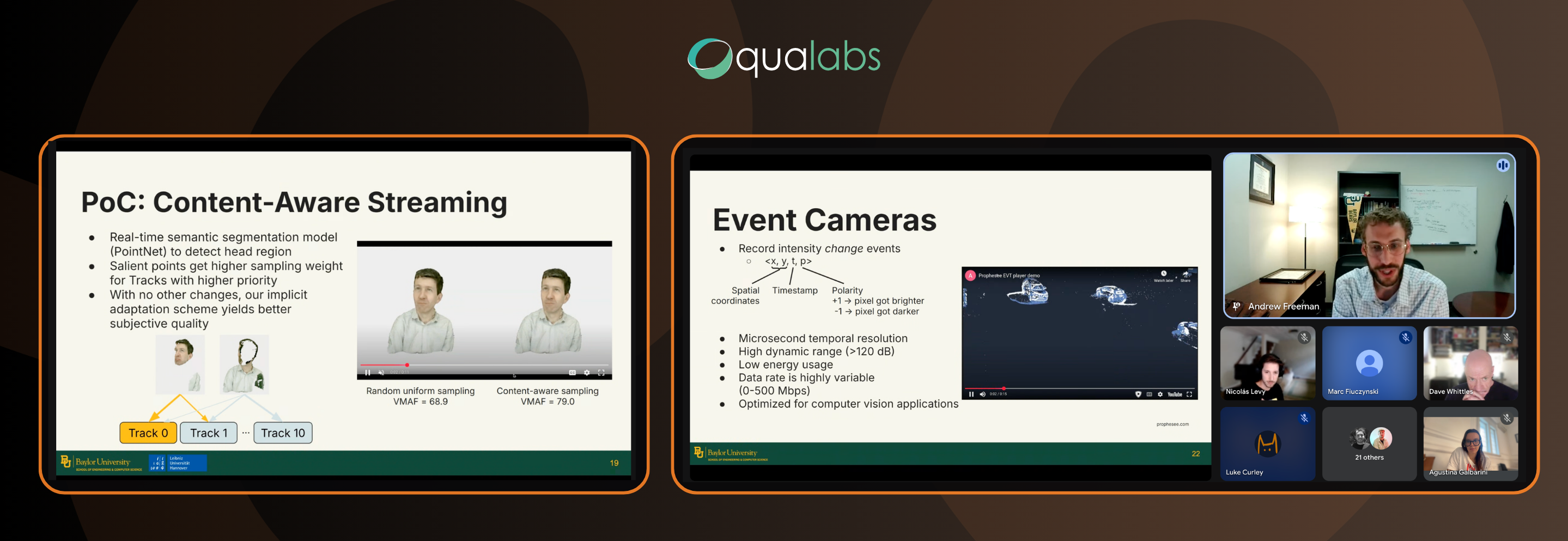
- Streaming Point Clouds: Managing massive frames by using MoQ’s tunable latency-quality tradeoffs.
- Event Cameras: Handling high-speed sensors that capture pixel-level changes rather than traditional frames.
- 4D Gaussian Splatting: Creating interactive 3D environments that adapt to user viewports automatically.
🎙️ Talk 2: Soft Binding in C2PA: Limitations, Opportunities, and the Role of Watermarking
As it becomes harder to distinguish real content from AI-generated media, the C2PA standard provides a mechanism for tracking the origin and history of digital assets. However, the current "Hard Binding" model where provenance metadata is embedded directly into the file presents a structural vulnerability.
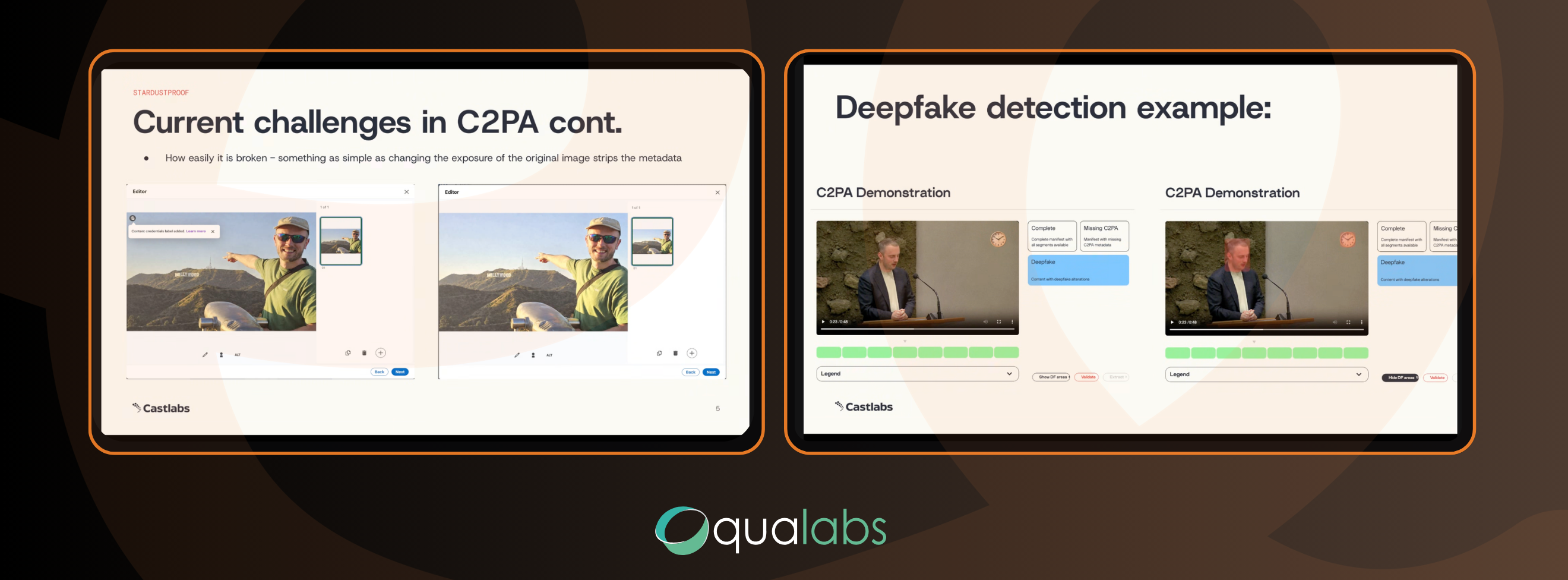
- The Fragility of Hard Binding: Metadata is frequently lost the moment a file passes through a tool or platform that does not support the C2PA standard. Adjusting the exposure of an image with a common editing tool, for example, often causes the signed manifest to disappear.
- Metadata Bloat: Repeated edits can cause the embedded manifest to grow significantly, adding friction to content transport and distribution.
Soft Binding as the Resilient Solution
The introduction of Soft Binding utilizes an invisible forensic watermark (steganography) to link the asset to externally stored provenance information. This connection can survive re-encoding, edits, or re-exporting, allowing forensic tools to generate detailed "damage heatmaps" that pinpoint which regions of a frame have been altered.
C2PA for Live Streams: Qualabs Implementation
Qualabs is actively moving this technology into the live streaming space. During the session, the current status of this development was highlighted:
"The signing for live spec is already complete. We're finishing the reference tools for signing and verification in a DASH player and we're planning to release it as open source within one to two months."
Final Takeaways
The infrastructure originally built for streaming was not designed for the level of interactivity and trust required today. MoQ and C2PA are not just incremental updates; they represent a fundamental rethinking of how content is distributed and authenticated. Neither challenge is fully solved, but both are moving toward a more resilient, transparent, and user-centric internet.
See you at the next Qualabs Tech Meetup!
A big thank you to Andrew Freeman and James Hynard for making this session possible and to everyone who joined online.
🔗 Full video replay available on our Youtube!