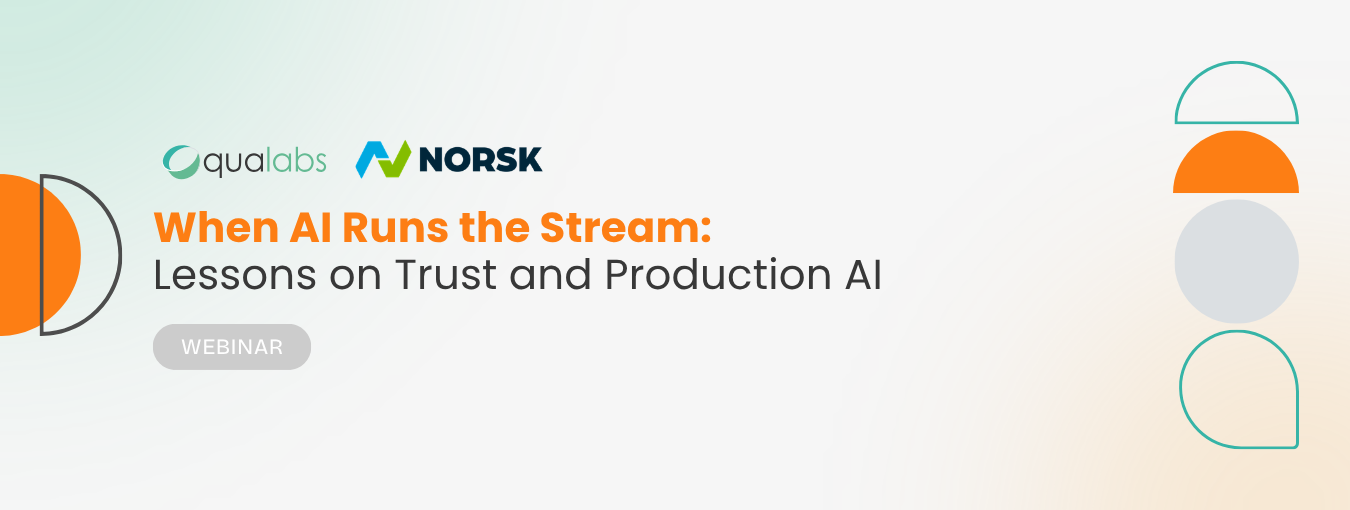
Every AI conversation in media starts with the same question: is it ready? Adrian opened by telling everyone in the room that this is the wrong question. And once he said it, it was hard to disagree.
"The question is not whether AI is ready. The question is which jobs it is suited for."
That single reframe carried the entire session. Adrian brought the technology side. JP brought the side that every broadcast engineer actually loses sleep over: what does it take to run this in production, on a real audience, without breaking what already works. Thank you to Adrian and to the Norsk team for the invitation, and to everyone who joined us live or sent in a question. This one is worth writing down.
The Jobs AI Is Already Doing Well
Adrian walked through what he called an AI readiness scale, and the honest version of it is more interesting than a hype cycle. Transcription, translation, and speech to speech are, in his words, close to solved. Monitoring and policy enforcement are strong candidates too, because an AI intervention there usually means getting a human involved at the right moment, not replacing one. Quality based source switching is another good fit, because the cost of a wrong call is close to zero for the viewer.
Then there is the harder end of the scale: automated monetization, live 16:9 to 9:16 conversion, and orchestration across studio components. Here Adrian shared something we found genuinely useful as a mental model. AI performs better the narrower you frame the problem. A wide, unbounded task like "produce this entire soccer match" is a poor fit. A narrow task like "follow the current speaker" or "detect halftime" is a strong one. Give the system a little wiggle room, make mistakes cheap when they happen, and keep an audit trail of every decision so you can tune it over time. Three simple rules, and they hold up whether you are building for enterprise events or live sports.
The Question That Actually Keeps Operators Up at Night
JP took the conversation somewhere different, and it is the part we think about the most internally. His opening line set the tone: for twenty years, broadcast ran on determinism. Set an encoder to 1080p, get 1080p, every single time. AI breaks that in two ways at once. You lose visibility into where a deterministic decision ends and a probabilistic one begins. And you lose predictability on cost, because a system that reasons and re-reasons does not price like an encoder does.
"The question is not 'can AI do this.' Every demo at every trade show already answers that with yes. The question is: can you run it a thousand times and trust the output every time?"
That is a production question, not a research question, and JP walked through two systems we run today that try to answer it honestly.
A QoE anomaly detection funnel
The first is a QoE anomaly detection funnel for large scale streaming. Instead of pointing an LLM directly at quality metrics, it works in layers. A deterministic threshold decides whether something is wrong. A pattern match decides why, for causes already seen before, with no model involved at all. Only when both of those come up empty does an LLM step in to reason about a genuinely new cause. And when it does, a human engineer reviews the explanation and, once approved, turns it into a deterministic pattern for next time. The system gets more predictable and cheaper the longer it runs, which is the opposite of what most people assume AI does to a cost curve.
A validator for AI generated highlight clips
The second is a validator for AI generated highlight clips. The insight here is simple and a little uncomfortable: if a generator produces a thousand clips, someone still has to check a thousand clips. That is not a saved bottleneck, it is a relocated one. So instead of building another generator, the team built the layer nobody had bothered to automate: a QC system that scores each clip against a spec, using deterministic checks for anything with an exact answer (black frames, logo position, duration) and semantic checks only where judgment is genuinely required (is the sponsor visible, does the commentary match the play).
One Thread Running Through Both Talks
Adrian and JP approached the topic from opposite ends, the possibilities and the guardrails, and landed on the same conclusion. The lasting value is not in any single model. Models are, as Adrian put it, the weather. The value sits in the orchestration around them: the workflow, the audit trail, the human checkpoint that turns a probabilistic guess into a deterministic rule you never have to question again. Own that layer, and you keep control of your own workflow. Rent it out to a vendor, and you end up paying to use your own process back.
There is a quieter thread too, and it came up in almost every answer during the moderated conversation: change management. JP mentioned that the anomaly detection system was not built as a chatbot. It was built to write runbooks, because that was the artifact the engineers already understood and trusted. The hardest integration was never into the media pipeline. It was into the human workflow around it.
What Comes Next
This session gave us more to unpack than one recap can hold, especially on JP's side of the conversation: the funnel design behind the anomaly detection system, the ground truth dataset behind the highlight validator, and the honest framework for deciding what should stay deterministic versus what genuinely needs a model.
Thanks to Adrian Roe and Eric Schumacher-Rasmussen for the invitation and for a conversation that stayed honest about where AI earns its place and where it still needs a human on the handlebars.
Want to see more of what happened at the webinar? Watch the full recording here.