
Challenge
Delivery dashboards track whether a segment request succeeded, but none of that tells an operator what a specific viewer is actually seeing right now. A session can be stepping down through renditions, stuttering, or freezing, and every delivery-layer signal will still read "normal." By the time anyone notices, it's a support ticket, not a metric.
The pain isn't specific to one platform, either: any operator, broadcaster, or streaming platform running standards-based delivery at scale — live sports, OTT, broadcast simulcast — inherits the same blind spot, and it grows with every session added.
MainConcept and Qualabs set out to close that gap using open standards already gaining adoption across the industry, CMSD and CMCD, part of the SVTA2128 (CTA-5004-B) spec family. The goal: carry a real perceptual quality score all the way from the encoder to a live, per-session dashboard.
Process
The team anchored the design on VMAF-E, MainConcept's neural-network estimation of VMAF built into their HEVC/H.265 and AVC/H.264 Encoder SDKs (part of its vScore suite). Unlike full VMAF, VMAF-E approximates the score to within about ±2 points directly from encoder features, in coding order — which matters because true VMAF's look-ahead makes it unusable inside a live, real-time pipeline. VMAF-E runs up to 10x faster, which is what makes real-time, per-frame scoring realistic in the first place.
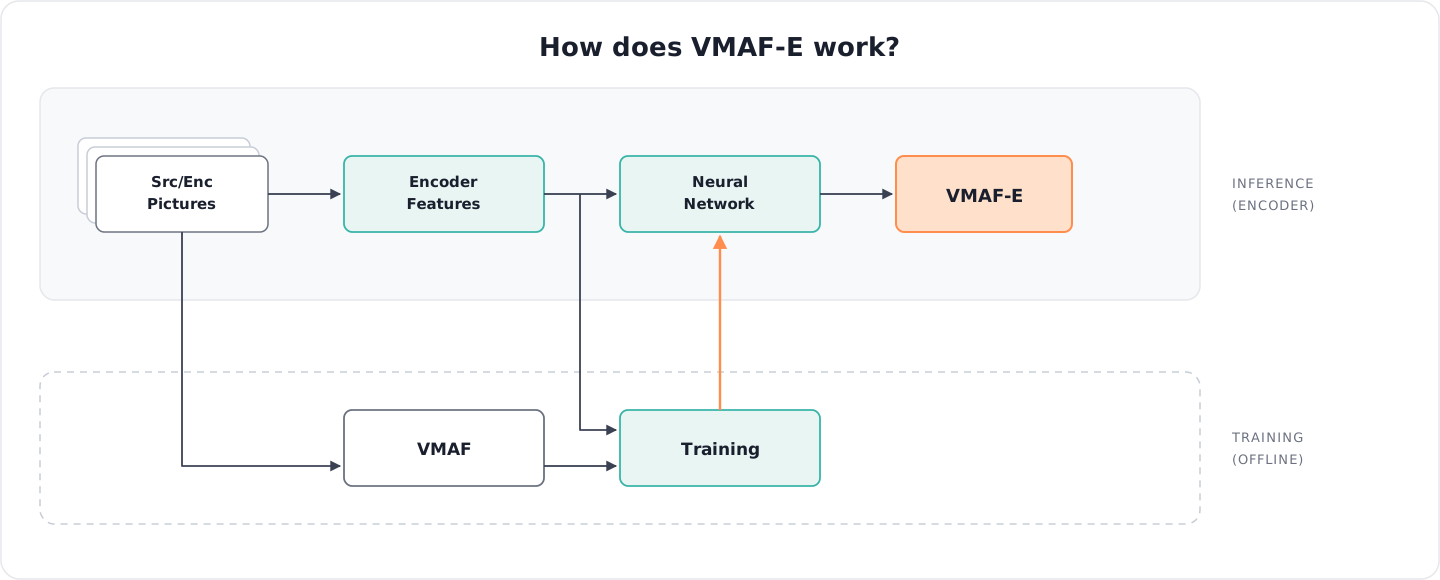
- MainConcept's encoder embeds the per-frame VMAF-E, PSNR, and SSIM scores directly in the HEVC bitstream, as a PREFIX_SEI NAL unit placed immediately before each frame's first slice — a proper part of the bitstream, not a sidecar file.
- Qualabs' origin server reads that SEI straight out of each DASH segment's
mdatbox — no re-encoding, no ffmpeg call at request time — and aggregates it to a per-segment score, exposed as an HTTP response header (CMSD-Static). - A standard, unforked dash.js player picks up that header and re-reports it via
CMCDv2's event-mode POST (the
cmsdsfield, fired on therrevent) — never appended to the segment's own request URL. - A collector decodes that field per session ID and renders a live dashboard: one row per viewer, updated as events arrive.
The team validated the implementation down to the byte. While checking the bitstream against the SVTA2128 registry, Qualabs and MainConcept aligned on two small formatting details in how metric values were being written, so the pipeline reads as fully spec-conformant, not just working by coincidence. The team also confirmed the SEI data survives standard packaging untouched — byte-identical after DASH stream-copy and after a live-simulation server.
Solution & Outcome
The result is a working proof of concept, end to end: a quality score computed once, at encode time, reaches a live, per-session dashboard intact — without adding a single extra network call.
By integrating MQA, an operator stops relying only on delivery metrics — which say nothing about the actual quality of what's being watched live, whether that's live sports, OTT, or broadcast simulcast. Alongside those metrics, they now get a perceptual quality signal per session, in real time: if there's a drop (from a rendition switch, for example), it shows up the moment it happens, tied to that exact session. That extra layer of analysis is what gives an operator something to decide from, instead of something to log after the fact, and it's adopted the same way it was built: no proprietary probes, no added network calls, no changes to how players or CDNs already work.
Stop by MainConcept's booth at IBC 2026 (#1.C15) and see what we built together!
Testimonial

Frank Schoenberger Director Strategic Partnerships at MainConcept
“The Qualabs and MainConcept teams brought this proof of concept to life in just a few days, addressing an everyday problem for OTT providers. Our MainConcept HEVC/H.265 encoder, with its vScore platform's per-frame VMAF-E perceptual analysis, forms the foundation of a full MQA pipeline, carrying a real perceptual quality score from the encoder to a live, per-session dashboard in the Qualabs origin server. That gives operators real-time quality feedback they can act on immediately. We're proud to share these first results with Qualabs at IBC 2026, and we're looking forward to jointly solving the pain points broadcasters and streamers face.”
About the Contributor
MainConcept, is a leading provider of video and audio codecs, plugins, and applications to the production, streaming, and broadcast industries. Its encoder SDKs power live and on-demand workflows across the industry, with vScore and VMAF-E built in to bring real-time, perceptual quality measurement directly into the encoding process.