Challenge
Create a joint PoC for NAB Show 2026, between Qualabs, Unified Streaming and WDR (Westdeutscher Rundfunk) covering the full pipeline from dynamic packaging to playback, bringing two independent systems together into a single, interoperable end-to-end implementation. That required deeply analyzing a spec that is still evolving, evaluating and defining new approaches for embedding provenance metadata in live video, and understanding the performance implications at every step.
Process
Both teams worked through weeks of close iteration, testing, aligning, and pushing until Unified Streaming's packager and Qualabs' validator produced fully compatible outputs under the same C2PA spec. Getting there required both companies to reach the same technical understanding of a standard that continues to evolve. The PoC implemented v2.4 of the specification, which is the most recent.
The starting point: Unified Streaming has one of the most powerful and widely adopted packagers in the industry, Unified Origin, trusted by major broadcasters and streaming platforms globally. Qualabs brought deep expertise in video workflows and open source standards implementation. And WDR, Germany's largest public broadcaster, contributed something equally valuable: broadcast content with full provenance metadata, organization, station ID, program name, grounding the demo in something the industry can recognize.
Decisions shaped how the implementation was built:
- Modular and open source: Structured as independent packages, signer, origin server, stream source, player plugin, UI, and testing tools, so different teams in the industry can take only what they need. Qualabs contributed the validator to the Common Media Library as a building block for the broader ecosystem.
- JavaScript validator for universal compatibility: The player-side validator runs in pure JavaScript so it works on every device where video plays: smart TVs, set-top boxes, gaming consoles, and embedded devices.
Solution
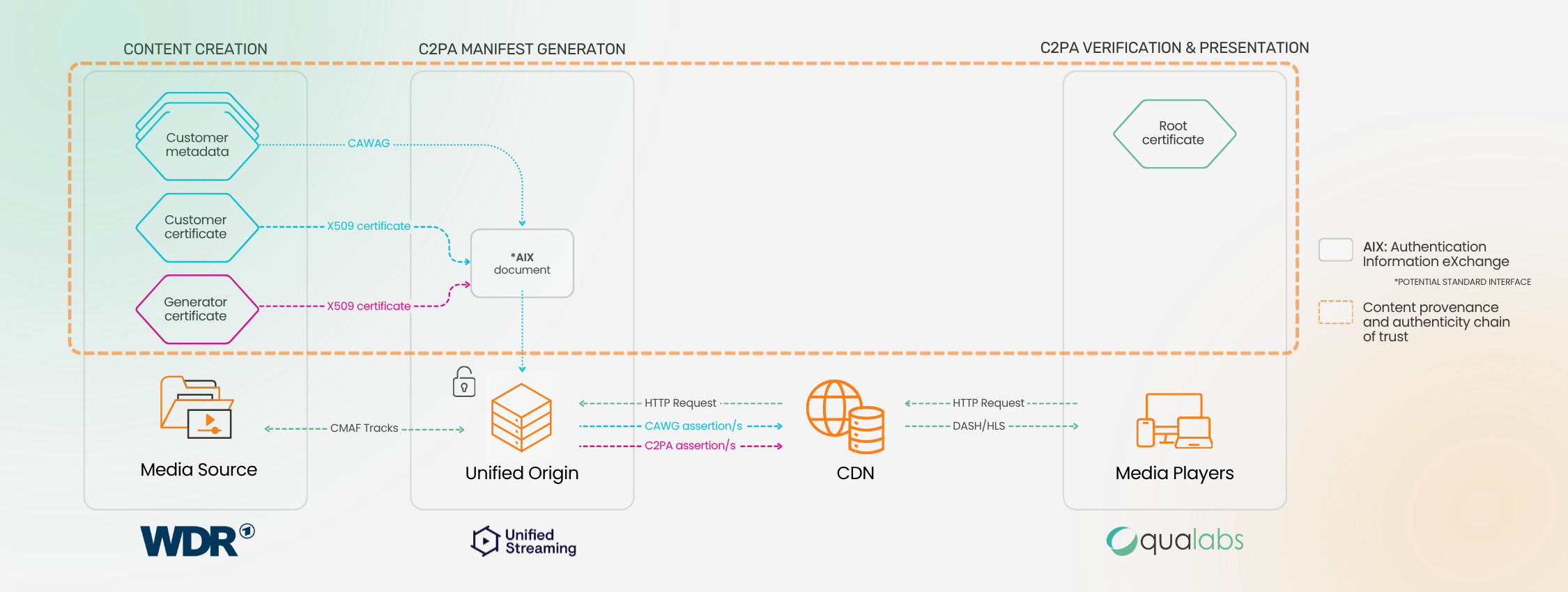
WDR content flows through Unified Streaming’s Unified Origin dynamic packager, which
signs each fragmented MP4 segment using the credentials from the generator and the customer, ready
for distribution. The CDN handles delivery. On the other end, Qualabs' validator runs inside the
media player and verifies every segment's cryptographic signature in real time as it plays,
confirming the content is authentic and untampered, without interrupting playback.
The
player surfaces Content Credentials directly in the interface, who produced the content (WDR) and
who signed it (Unified Streaming), giving operators and audiences a transparent, verifiable chain
of provenance.
Result
This prototype demonstrates the first end-to-end implementation of C2PA for live and on-demand video, showing how real-time signing and validation work in practice. It illustrates how provenance can be embedded into streaming workflows and how authenticity information travels with video across platforms.
Stop by Unified Streaming’s booth at NAB 2026 (W.2161, West Hall) to see real-time media authentication in action.
What it shows and why it matters:
- C2PA applied to dynamic video workflows Shows how authenticity signals are added during packaging and delivery for broadcasters, streaming platforms, and content owners to protect and verify video.
- From concept to implementation Helps media teams understand how a provenance solution integrates into existing workflows without any major infrastructure changes or impact on performance.
- Interoperability in action Shows how platforms, publishers, and third-party systems exchange and validate provenance data across multi-vendor ecosystems.
- Provenance that travels with content A news clip shared on social media can still be traced to its source. A sports highlight can be verified as official footage. A viral video of a public figure can be checked for manipulation or AI-generated edits.
- Foundation for industry adoption Provides a reference approach for broadcasters, platforms, regulators, and rights holders to implement verifiable authenticity at scale as standards mature.

Linzi McRae Product Manager at Unified Streaming
“Working with Qualabs allowed us to quickly turn a complex standard like C2PA into a working prototype in a real streaming environment. For Unified Streaming and WDR, this demo shows that verifiable media authenticity can be integrated into existing workflows and that provenance can travel with video across platforms, providing a practical foundation for trust in digital media.”
About the Contributors
Unified Streaming is a software company that helps broadcasters, streaming services, and content owners stream, reuse, and monetize content globally. Their Unified Origin product is an industry-grade origin server trusted by major operators worldwide.
WDR (Westdeutscher Rundfunk) is Germany's largest and most influential public broadcaster, reaching millions of viewers daily from its headquarters in Cologne as a core member of ARD, the national public broadcasting consortium.