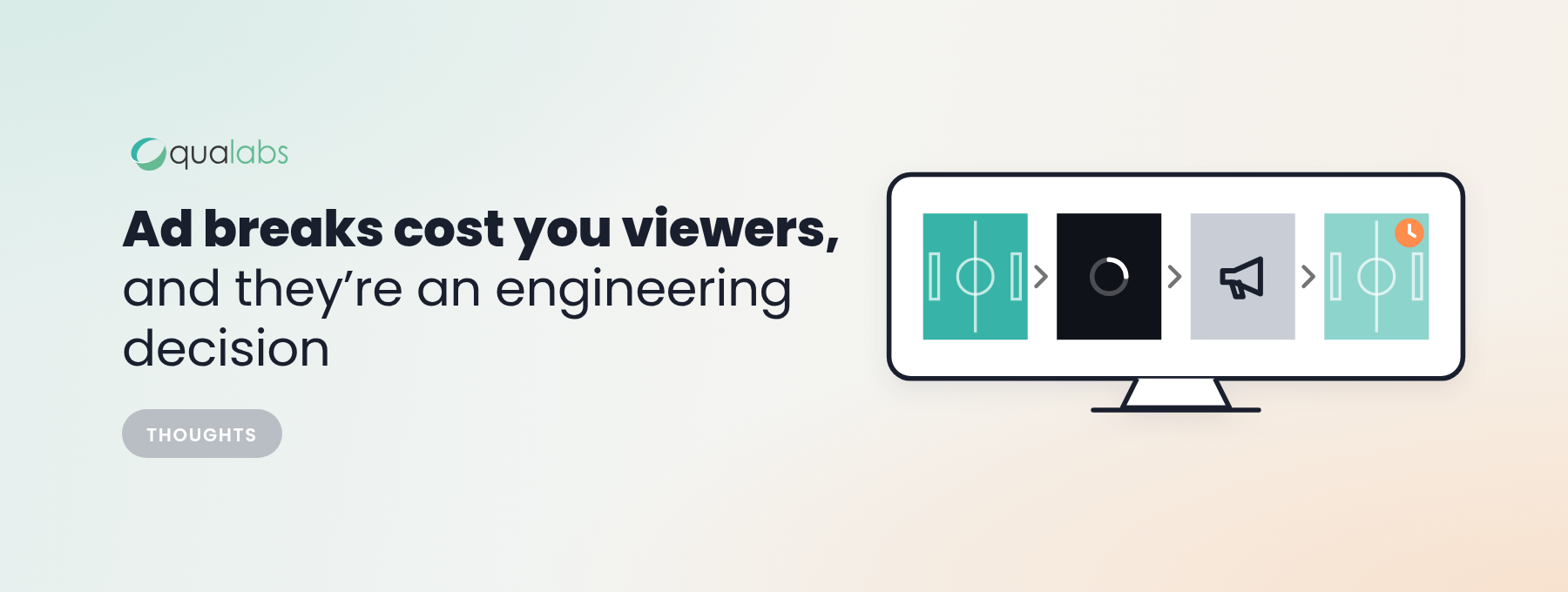
A hydration break in a soccer match. The broadcaster marks the break, your platform plays the ads and the game resumes. On some screens, the viewer is still watching the last ad, or a loading spinner. By the time they're back, the play is over.
The broadcaster decides when the break starts and ends, with its SCTE-35 signal. What each viewer sees in those seconds, and when they get back to the game, is decided by your platform's engineering. At many services, nobody made that decision on purpose: it came with the first vendor or the first player.
Why is the ad break where you lose viewers?
Because it's the moment viewers have the fewest reasons to stay, and any technical glitch gives them one to leave. Only about one in three viewers keeps watching the screen during the break; the rest pick up their phone or get off the couch.
Glitches make it worse. A 2026 study of live sports viewers found that when the break goes wrong, three times as many people find the ads intrusive. Delays and loading spinners during the break raised negative reactions by 84%, and abrupt or choppy transitions by 97%. For 62% of those viewers, what matters most is not missing anything and getting back to the game fast.
You pay that cost, not the advertiser: the viewer who comes back late blames your service. And falling behind the action already has a price: 14% of live sports viewers have considered switching providers because their coverage ran behind the action.
What does engineering decide in an ad break, and what doesn't it?
Engineering decides how the break looks and when each viewer gets back; it doesn't decide when the break starts or which ads run. Separating the two tells you who to ask for what:
| What happens in the break | Who decides |
|---|---|
| When it starts and ends | The broadcaster, with its SCTE-35 signal |
| Which ads run and how often they repeat | Your ad server and your sales team |
| Whether the transition shows loading, black frames or picture jumps | Your insertion model and your player |
| Whether the viewer gets back to the game on time | Your insertion model and your player |
| Whether every device behaves the same | The implementation in each player |
The last three rows are engineering, and they're the ones your viewers live through. That's the decision worth making on purpose.
What changes for the viewer between SSAI, CSAI and SGAI?
Where the break gets assembled, and with it, what can go wrong on screen.
With server-side ad insertion (SSAI), the ad is stitched into the same video stream and the transition is usually clean. But personalization takes a manifest per viewer, which gets expensive to generate and deliver when a live audience spikes. And if the ad wasn't encoded the same way as the content, the jump shows up anyway.
With client-side ad insertion (CSAI), the player requests the ad and plays it. It's flexible, but every request and every switch between players adds seconds of loading, and on a live stream the viewer comes back behind the game.
With server-guided ad insertion (SGAI), the server marks the break in the manifest and the player fetches and plays the ads. It personalizes without a manifest per viewer and lets you cap how long the break runs on each screen. Its risk is a different one: it depends on every player implementing it well.
Many teams run more than one. In 2025, 64% of video teams used CSAI, 63% used SSAI and 21% already used SGAI. Each combination behaves differently on each device.
- What the viewer sees
- A single stream. The transition is clean if the ad is prepared well.
- What you risk
- The cost of a manifest per viewer at peaks, and jumps if the encoding doesn't match.
- What it asks of your engineering
- Prepare ads the same way as the content and scale manifest generation.
- What the viewer sees
- The player switches to the ad, then back to the content.
- What you risk
- Loading and black frames at the transition, and coming back late on live.
- What it asks of your engineering
- Preload ads and control the return on every player.
- What the viewer sees
- A transition the player handles with instructions from the server.
- What you risk
- Each player and each device behaving differently.
- What it asks of your engineering
- Implement and test the standard on every player, with break duration caps.
- What the viewer sees
- The game stays on screen, with the ad beside it or on top.
- What you risk
- Formats and measurement the industry is still defining.
- What it asks of your engineering
- Show the ad without cutting away from the game and measure it the same way on every device.
For a deeper look at how each technique works, with diagrams and manifest examples, read Where is the ad decided? CSAI, SSAI and SGAI explained.
Why is SGAI gaining ground in live streaming?
Because it personalizes without the cost of a manifest per viewer and gives the server control over the return to content. In September 2026, a European public broadcaster moved advertising on all its channels to SGAI, both live and on demand.
The standards have matured too: in HLS, SGAI builds on interstitials, and the 6th edition of MPEG-DASH formalized the mechanism, with controls to get back to the main content on time. Our team prototyped early versions of that mechanism before it was published, and Nicolás Levy, our CTO, co-authored the technical paper that explains it.
But SGAI doesn't fix the break on its own: the server gives the instructions and each player carries them out its own way. Our team built a live SGAI proof of concept that turns standard ad server responses (VAST) into break markers in the HLS manifest, driven by SCTE-35 signals. The player plays the ads without stitching them into the stream, and measurement stays complete; we showed it live at Mile High Video 2025. The work you don't see in a diagram is getting every player, on every device, to run the break the same way.
What are non-linear ads, and when do they make sense?
They're ads that share the screen with the content instead of replacing it: a lower-third banner, a split screen or a frame around the game. The game never leaves the screen, so nobody comes back late.
Sports viewers are open to them: more than half are positive about a lower-third ad during a live game, and half feel the same about a split screen. For your business, they're inventory in moments where a full break doesn't fit.
The challenge is engineering: the ad has to appear without cutting away from the game, look the same on web, mobile and connected TV, and be measured as rigorously as a video ad. At Apple's HLS Interest Day we showed non-linear ads running on web (with hls.js), iOS and Roku, and we're working on the SVTA non-linear ads specification.
They don't replace the ad break: they add inventory without taking the viewer out of the game.
What should you check in your ad breaks before your next live event?
Six checks your team can run with a recording of your last event and the devices your audience uses most:
- When each device comes backOn each player, compare when the game resumes with when your viewer gets back.Return
- What each transition looks likeRecord the way in and out: loading, black frames, picture jumps.Transition
- How far behind live each break leaves youMeasure whether the gap to live grows break after break.Return
- Which insertion model each device usesIf nobody knows offhand, the decision was never made.Decision
- How much audience you lose in the breakAudience before the break versus audience on return, by device.Audience
- Where a non-linear ad fitsMoments when the game stays on screen and an ad could run alongside it.Non-linear
How Qualabs helps keep ad breaks from costing you viewers
Our Specialized Engineering team works on the part of the break your viewers experience: the transition, the return to content and how each player behaves. With your team, we focus on three things:
- A diagnosis of your breaks on every player and device, covering the transition, the return to the game and the lag behind live, to show you where you lose audience and what to fix first.
- A move to SGAI without breaking what already works, with implementation and testing on each player, SSAI coexistence on devices that don't support it yet, and duration caps that bring viewers back on time.
- Non-linear ads on your platform, from the player on web, mobile and connected TV, or inside the video frame itself with our Video Tile Ads accelerator, so you sell inventory without taking viewers out of the game.
If you have a live event on the calendar, tell us which devices your audience uses and we'll review what happens in your breaks before it starts.