
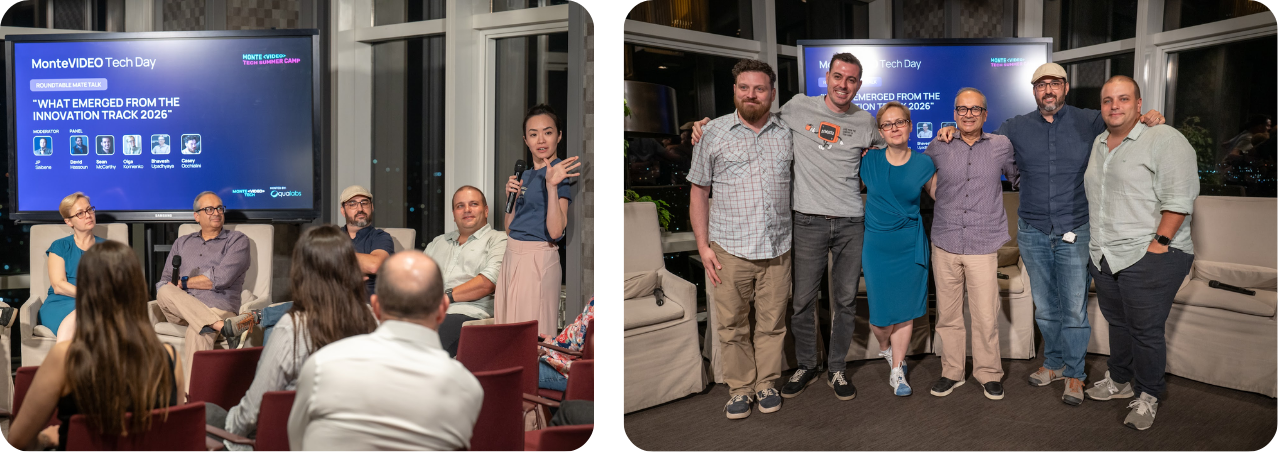
As part of Summer Camp – Montevideo Tech Day 2026, this edition of Mate Talk brought together David Hassoun, Sean McCarthy, Olga Kornienko, Casey Occhialini, and Bhavesh Upadhyaya to reflect on what truly emerged from Innovation Track in Punta del Este.
What happened the previous weekend wasn’t just a series of discussions, it was a structured attempt to move beyond industry frustration and toward venture-ready solutions.
The roundtable focused on a central question:
If we strip away company silos and short-term constraints, what are the real structural problems Media Tech must solve right now?
Three interconnected domains stood out:
- Metadata integrity across workflows
- Advertising and experience architecture
- Rights management and programmable enforcement
But more importantly, the conversation wasn’t about abstract innovation. It was about translating those friction points into actionable opportunities, ideas that could realistically evolve into products, companies, and long-term infrastructure plays under the Montevideo Tech Ventures lens.
From Industry Pain to Structural Clarity
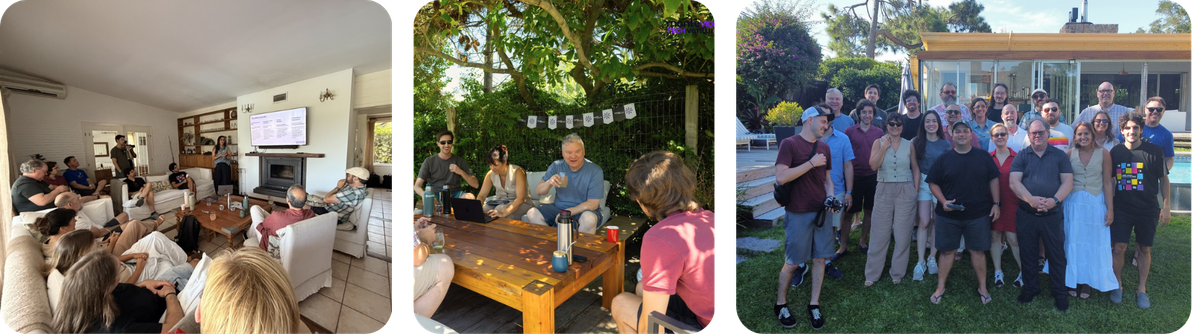
Innovation Track took place on January 24 - 25 in Punta del Este, Uruguay bringing together a small group of operators, engineers, and founders for two days of focused working sessions. The setting created the space for deliberate thinking around the structural friction embedded in today’s media ecosystem.
The objective was to examine recurring industry challenges with enough rigor to determine whether they reflected isolated inefficiencies or deeper architectural gaps. As the discussions progressed, a clearer pattern emerged: many operational bottlenecks stem from misaligned layers across the media stack rather than individual system failures.
Over those two days, the perspective shifted from optimizing workflows to questioning foundational design. The group moved beyond incremental improvements and began identifying where structural components are missing and where new infrastructure could unlock value.
That shift introduced economic realism and ownership into the conversation. Once a gap is defined at the architectural level, the next question becomes inevitable: who builds it?
And that mindset carried directly into the Mate Talk.
The Metadata Layer: Integrity as Infrastructure
One of the strongest threads carried into the Mate Talk was the structural weakness around metadata continuity.
Across the content lifecycle, contextual information is constantly created and transferred between systems. The issue is not the absence of data, but its fragmentation. As assets move across platforms and vendors, context erodes, turning what should be a continuous layer into disconnected snapshots.
The impact goes beyond operational inefficiency. It leads to decisions made with partial visibility and increasing workflow isolation.
The discussion made clear that metadata integrity is not a tooling problem but an architectural one. Without a persistent and interoperable reference layer, systems cannot preserve meaning consistently across the stack.
Instead of proposing another proprietary standard, the focus shifted toward aligning around a shared identifier capable of acting as connective tissue across the ecosystem.
The question moved from “how do we store more data?” to “how do we preserve meaning across systems?”
That reframing positioned metadata not as operational overhead, but as foundational infrastructure.
Advertising & Experience: Structural Limits
The advertising discussion quickly moved beyond targeting improvements and incremental monetization tactics. The group identified a deeper constraint: many personalization strategies are limited by the underlying playback and rendering architecture rather than by data or business logic.
Teams often attempt to innovate at the application layer while the delivery stack itself imposes structural ceilings across devices. One direction explored was whether more advanced codec capabilities and multi-source composition models could introduce flexibility at a deeper layer of the system. The question was not how to insert smarter ads, but whether the rendering model itself needs to evolve in order to support more contextual and adaptable experiences.
The conclusion was pragmatic. Sustainable innovation in advertising will require architectural changes below the surface layer, not just optimization on top of existing constraints.
IP, Rights & Programmable Enforcement
The IP discussion focused on the mismatch between static contractual frameworks and dynamic distribution environments. Rights agreements define constraints, but those rules rarely live inside the systems that execute content workflows.
One direction explored was translating contractual logic into programmable rules embedded directly into distribution infrastructure. In this model, rights holders define structured constraints, creators operate within transparent parameters, and content-aware systems monitor compliance in real time.
The goal is not tighter control. It is scalable alignment between protection and flexibility.
The Turning Point: From Discussion to Ventures
The defining moment came when each group was asked to move beyond analysis and outline a solution that could realistically become a company.
Once the question shifted to who would pay, how it integrates, and where the value is captured, abstraction disappeared. Ideas were forced into structure. Problems were reframed as products.
The conversation stopped being exploratory and became executable. That transition is what connected Innovation Track to Montevideo Tech Ventures.
What this signals for Media Tech
Innovation Track 2026 showed that the industry’s most persistent bottlenecks are not isolated technical flaws. They are architectural gaps that require ownership.
The real shift was not in identifying problems, but in committing to build the missing layers of the stack with venture discipline from the start.
Media Tech does not lack talent or ambition. It needs infrastructure that aligns technical design with economic incentives.
That alignment is where the next generation of companies will emerge.