When we went to Mile High Video 2026, the real buzz for us was MoQ. We’ve been experimenting with the standard for a couple of years now, pushing it forward through open-source-driven challenges we deliberately took on. But this time felt different. The conversations weren’t about potential they were about viability.
Engineers weren’t asking what MoQ is. They were asking:
- How to adopt MOQ on actual workflows?
- How to use MOQ as a ingest content to replace WebRTC and RTMP?
- Where does it sit inside an existing production architecture?
- How do we measure and debug it at scale?
That shift in questioning tells you something important: MoQ is moving from curiosity to architectural evaluation.
The Adoption Story of MoQ is also the Story of QUIC and WebTransport
If you want to understand where MoQ adoption is heading, you need to understand its transport foundation.
MoQ builds on QUIC, which immediately gives it performance and congestion-control advantages over legacy transport models. But the browser story is equally important: WebTransport opens the door for MoQ to operate in environments that traditionally required WebRTC or HTTP-based delivery.
This dual capability changes the adoption equation.
It means MoQ is no longer confined to experimental native implementations. It can realistically be evaluated in browser-based workflows, which lowers the barrier for product teams exploring low-latency or real-time distribution strategies.
The big hurdle everyone comes back to: CDNs and relays
Here’s the tension nobody can dodge: MoQ is designed for high scale and low latency and explicitly accounts for intermediary distribution, yet integrating it into how CDNs operate today requires architectural evolution.
MoQ runs over MoQT (Media over QUIC Transport), a transport layer designed to be agnostic to the type of data it carries, whether video, audio, or other media objects. By structuring content into discrete objects, MoQT enables delivery patterns that can be cached and distributed at scale. That object-based model is precisely what makes MoQ relevant to CDNs, as it opens the door to scalable distribution without being bound to traditional HTTP semantics.
As a result, the conversation is increasingly focused on how CDN infrastructure can support MoQT natively. This is no longer theoretical. Major CDN players are actively working in this direction. Cloudflare, for example, has deployed relay infrastructure globally to enable MoQ prototyping. At the same time, initiatives like OpenMoQ are bringing together CDN providers such as CDN77 and Akamai to advance real-world MoQT adoption.
This is where the near-term adoption path becomes realistic:
- start with controlled environments such as contribution and ingestion workflows,
- validate measurable latency and efficiency gains,
- and expand into broader distribution as relay patterns mature.
MoQ is built for scale. The key variable now is how quickly CDN infrastructure incorporates native support for its transport model.

“MoQ vs WebRTC vs HLS” Is the wrong framing: This is about industry collaboration
What feels different now is collaboration shaped by experience, rather than competition between protocols.
The engineers and architects who helped define RTMP, HLS, DASH, and WebRTC are now participating in the same conversations about what comes next. They bring with them years of operational knowledge about scale, latency trade-offs, congestion control, synchronization challenges, and the realities of running production systems at global scale.
Each generation of streaming technology solved a different problem. RTMP simplified contribution workflows. HLS and DASH demonstrated how HTTP-based delivery could scale reliably across CDNs. WebRTC pushed real-time interactivity into production environments.
MoQ reflects the accumulation of those lessons and represents a natural evolution of the ecosystem. It builds on established foundations while incorporating the operational realities the industry has learned over the past decade. The focus is on refinement: designing a transport approach that can support real-time delivery, low-latency streaming, contribution workflows, and broader distribution models within a more coherent architectural framework.
That is why the conversation at Mile High Video did not revolve around which protocol wins. It centered on how the streaming landscape is advancing and how the next generation of transport can integrate the hard-earned lessons of previous technologies.
Observability is no longer optional MoQ needs a measurement story
If you want MoQ to move from demos to production, you need confidence:
- How do you detect delivery issues?
- How do you debug performance regressions?
- How do you prove QoE wins during rollout?
What’s exciting is that measurement isn’t being treated as an afterthought. There’s active work on sending metrics information over MOQT, which speaks directly to the “production readiness” question people kept bringing up.
This is exactly the type of trend I’d rather connect than forcing unrelated standards into the story: it’s MoQ-native, it’s adoption-critical, and it’s aligned with how engineering teams actually de-risk new transports.
What we showed from Qualabs: tangible MoQ work you can explore
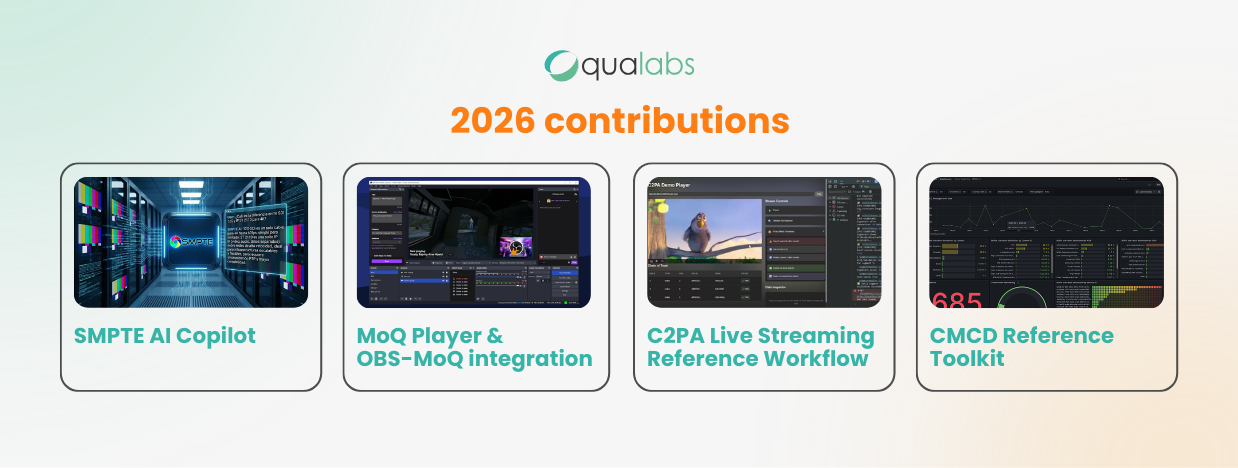
We brought more than 10 demos to our booth at Mile High Video. MoQ was one of them, but it sat alongside other major industry trends we’re actively working on, including AI-driven workflows and C2PA-related initiatives, and many more.
If you want to explore what we’ve been building you can discover more on our technology website