
The Evolution of Ad Insertion in DASH
Dynamic ad insertion evolved together with MPEG-DASH itself.
MPEG-DASH was designed as an adaptive streaming protocol where the Media Presentation Description (MPD) acts as the control layer for playback, defining structure, timing, and available media representations. From early versions, the MPD and its timeline model enabled coordinated switching and event-driven behavior during playback.
As OTT monetization matured, two dominant insertion models became common.
- Client-Side Ad Insertion (CSAI) relies on the player to request and integrate ads. It preserves HTTP scalability and CDN efficiency, while increasing player-side complexity.
- Server-Side Ad Insertion (SSAI) performs stitching on the backend, simplifying playback while introducing distribution considerations around manifest handling and caching under high concurrency.
Over time, implementations increasingly relied on DASH’s timeline-aligned event mechanisms to coordinate switching between main and alternative content. Those capabilities, implemented in mainstream open-source players, enable deterministic transitions at specific presentation times.
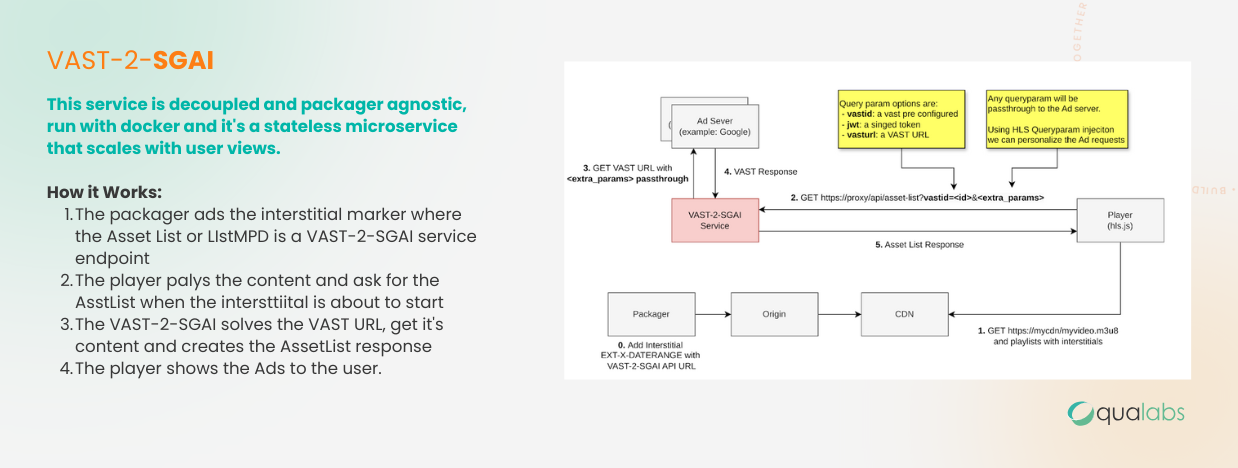
Server-Guided Ad Insertion (SGAI) builds on this foundation. It maintains server-controlled decisioning while using the MPD and timed events to orchestrate client-executed switching in a structured way.
The 6th Edition formalizes this evolution through Alternative MPD Events, defining clearer semantics for how alternative content is introduced and resolved. The objective is architectural precision: a more explicit contract between server signaling and client execution, grounded in DASH’s timeline and event processing model.What the 6th Edition Formalizes
What the 6th Edition Formalizes
The key advancement is the introduction of Alternative MPD Events, replacing earlier XLink-based mechanisms.
This update defines:
- A structured event registration and execution model
- Clear Presentation Reference Time (PRT) alignment
- Explicit insertion and replacement semantics
- Maximum Alternative Playback Duration (APDmax) controls
- A formal SGAI Endpoint separating business logic from playback resolution
The result is a clearer server/player boundary for predictable switching behavior, including live and high-concurrency scenarios.
Technical Highlights from the Paper
The publication dives into several implementation-relevant details:
-
Event processing
Alternative MPD Events are registered into an event table and executed via a defined queue model. Execution is aligned with the playback timeline, enabling deterministic switching behavior.
-
Prefetch windows and concurrency management
Clients may resolve alternative MPDs within a defined prefetch window (commonly 8–60 seconds before execution). This reduces synchronized ad decision spikes during large live events, a practical scalability requirement for FAST and global broadcasts.
-
Return-to-network control
Through APDmax, the specification enables bounded alternative playback duration, supporting safe and predictable return-to-main content while preserving timeline integrity.
-
Stateless targeting
Targeting parameters can be passed in a stateless manner, improving cache friendliness and reducing dependency on persistent client context.
Implementation and Collaboration
The paper references implementation considerations in mainstream open-source players such as dash.js and Shaka Player, grounding the mechanism in real deployments.
In this edition, Nicolás Levy (VP Technology @Qualabs) appears as co-author alongside Alex Giladi (Principal Architect @Netflix) and Thasso Griebel (Technical Lead Player Development @castLabs).
Qualabs invested significant effort in prototyping early versions of Alternative MPD, aiming to generate early insights and identify opportunities for improvement before the 6th edition of MPEG-DASH was officially published. This hands-on work helped bridge specification design with practical production considerations.
Why this matters now
Advertising and monetization are a core part of many streaming business models. FAST growth, live sports concurrency, and global OTT expansion require:
- Predictable manifest switching
- Cache-aware architectures
- Clear separation of business and playback logic
- Interoperable implementations across players
The 6th Edition of MPEG-DASH provides a formal foundation for SGAI under these conditions. For engineers building ad-supported streaming systems, this paper offers a concrete reference for how the mechanism is intended to operate in practice.
Closing
What we’re doing at Qualabs goes far beyond delivering projects. We’re actively collaborating, prototyping, challenging assumptions, and contributing to the evolution of the industry itself.
Participating in the formalization of mechanisms like Alternative MPD Events reflects a broader commitment: shaping Media Tech through engineering, shared knowledge, and long-term collaboration.